
News & Events
Amy Beashel on We Are All Constellations
31st October, 2022
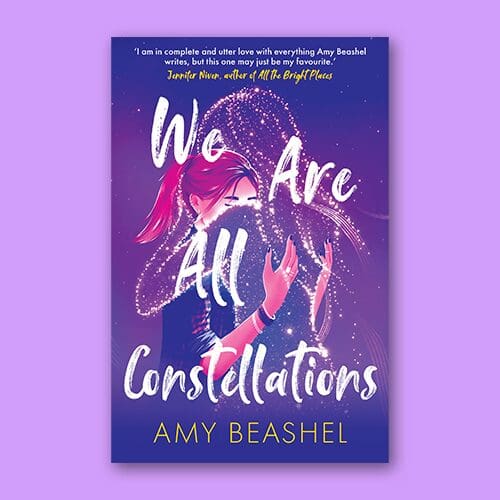
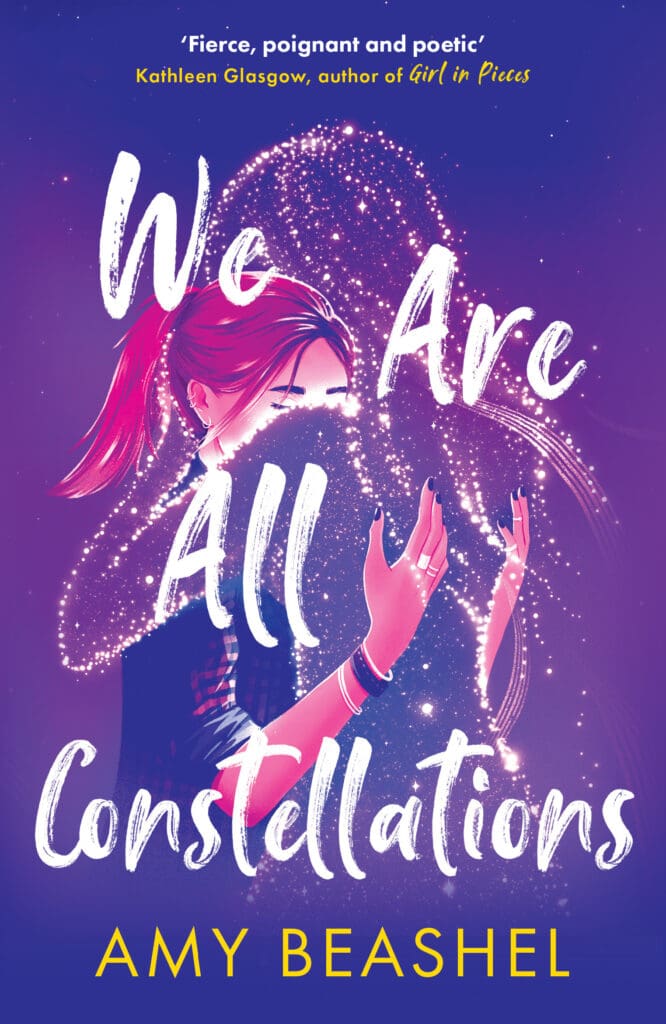
We Are All Constellations by Amy Beashel is a heartbreaking but hope-filled tale about the stories we tell ourselves to survive. Here she gives an insight into her inspiration behind the novel.
“My writing is always personal. That’s not to say it’s autobiographical, rather the stories begin with an experience or emotion that’s true to me because this is where the fire strikes, where the kernels of a character are revealed in their starkest form.
In We Are All Constellations, Iris is quietly and perhaps unknowingly grieving. Like everyone, I’ve lost people I love, but in recent years, I lost a place I love too. Unlike Iris’s dead mother, that place still exists, but it’s no longer somewhere I call home. With the move, the future I imagined for my family necessarily shifted, which isn’t to say the alternative is terrible – far from it, our new home is beautiful and our possibilities endless, but…
Grief persisted. And it really was, is, grief.
There is something missing, a part of me emptied and aching with sharp and painful regret. To admit I felt this way was, I believed, ridiculous. There are, of course, far more significant losses. And I have a fantastic life. Who am I to feel sad about what could have been. So, I sucked it up. Put on a brave face. Vowed to make the best of what I declared an exciting situation. In other words, I did what Iris does in the book and ignored my gut.
The thing is, grief waits for you. It speaks to you in whispered voices no matter how much you try to push it away, refusing to go anywhere until you talk about it. And then, in those honest conversations, you might stand a chance of setting it – and yourself – free.
This isn’t only true for grief. After the death of a friend a few years ago, I began volunteering for Samaritans, a listening service that supports people and communities in times of need. It was in these telephone calls and emails with strangers that I began to truly recognise the importance of having a place in which people can speak openly about any kind of feeling without fear of judgement or consequence.
Books can offer a similar sense of freedom, a space for readers to explore their emotions, to question not only the characters’ interiority but their own too. Because in seeing other people’s – albeit fictional – messy lives laid bare, our own complexities can begin to feel less extraordinary and more like something we can acknowledge, discuss and own.
This is particularly true in YA, a genre I love for its deep dive into the big issues: racism, misogyny, identity politics to name but a few. It’s not original to say I wish the kinds of books that are being written now were available ‘in my day’, but it’s true. And I suppose in writing We Are All Constellations, I wanted to give Iris – a young woman who is afraid of so many feelings – the courage to be very honest about, and excited by, some which I found – and still find – particularly hard to articulate.
An early reader fed back that they wanted Iris, who – spoiler – having only ever had relationships with boys unexpectantly falls for a girl, to label her sexual identity. I was resistant to do this, reasoning that the ethos of Iris’ story is to move away from her tendency to nail her friends and family to a particular trait and instead try to see their broader, fuller selves. But another part of me understood why the reader asked for clarity, that perhaps it is because labels can help us help us identify people we want to connect with, and that there may be satisfaction and possibly even security in saying ‘I am X’.
Personally, I’ve not often had to declare my sexuality aloud. I am in a monogamous marriage with a man. My sexuality, then, isn’t something that ever comes into question. And anyway, what business is it of others who I fancy or have chosen to sleep with in the past.
While writing We Are All Constellations, I asked myself whether I would be prepared to talk openly about the relationship that inspired Iris and Órla’s romance, and I didn’t really have a firm answer. For while – in an industry that is quite rightly focussing on own voices – it seemed like the ‘right thing’ to do for the book, I wasn’t sure it was the ‘right thing’ to do for me. My debut publishing experience taught me it’s scary enough putting a novel out into the world – while my more rational brain knows reviews aren’t personal, the less positive reactions to your work can feel like a judgement – did I really want to up the ante by risking other kinds of judgements too?
But if my hope is that readers might discover and embrace their full selves through reading, should I not grant myself the same privilege?
So, yes, Iris and Órla’s story echoes my own very lovely teenage experience.
Do I feel like I need a label? Honestly, maybe it’s fear that’s making me say, I’m not sure.
Because I do label myself in so many other ways.
I am a writer, a wife, a mother, a daughter, a sister, a friend, a Samaritan, a world-record holder in space-hopping, a book lover and runner, a hot-chocolate drinker and Caramel-Bunny detester, who loves podcasts and dislikes fish.
What I really am, then, is like Iris, like all of us, a constellation, still discovering and learning to love my many and varied stars. ”
We Are All Constellations is out now.